

Why nobody quotes a single number
Custom software development cost is genuinely hard to state as one figure, and the reason is not evasiveness. The price tracks the number of distinct things the software has to handle — user roles, integrations, workflow rules, exceptions — and that count is invisible until someone has looked at how the work actually runs.
Two companies of identical size can be an order of magnitude apart. A fifty-person business with one workflow and two roles is a smaller build than a five-person business coordinating four supplier systems across three currencies. Headcount and revenue are poor predictors; complexity of the process is the whole story.
What follows is how the number is built up, indicative ranges by project size, and what arrives after launch. Every figure here is a planning aid — a way to know whether you are in the right conversation — not a quote.
The five cost drivers
Almost all of the variance between two quotes traces to these five.
Number of distinct user roles
Each role is a separate set of screens, permissions and rules. A system used by one kind of person is not half the size of one used by two — it is closer to a third, because every shared screen now needs conditional behaviour and every rule needs testing from both sides.
Integrations with other systems
Each connection to an outside system — payment gateway, accounting package, SMS provider, logistics API, a legacy database — carries its own authentication, error handling, data mapping and failure modes. Integrations are also where estimates go wrong most often, because the other system’s documentation is optimistic surprisingly frequently.
Workflow rules and exceptions
“An order goes to the warehouse” is one rule. “An order goes to the warehouse unless it is over fifty thousand, in which case a manager approves it first, unless the customer is on the pre-approved list, unless their credit is on hold” — that is four rules and six test cases. The exceptions are where the cost is, and they are almost never in the first brief.
Data volume and migration
Moving five years of records out of an old system is a project in itself. Real data is messier than sample data — duplicates, missing fields, three spellings of one supplier — and cleaning it is work whether it is done by your team or billed by ours.
Compliance and audit requirements
Payments, healthcare data, personal data and anything with a regulator attached raise the floor on architecture, logging and testing. This is not optional scope, and if it is absent from a quote for a regulated system, it is a gap rather than a saving.
Where the money goes
Within a typical build, the split across phases is fairly stable. It is worth knowing because it explains why a quote that is only for “the code” is not comparable to one that covers a project.
Indicative ranges by project size
The bands below reflect what these systems typically cost when built by an experienced team in India, inclusive of discovery, design, build, testing and handover. Rates in North America and Western Europe commonly run three to five times higher for equivalent scope.
Focused tool — one workflow, one or two roles
Replaces a specific spreadsheet or a manual routine. A stock-issue log, a job tracker, an admin panel over data you already hold. Six to ten weeks.
- ₹6–15 lakh
- ≈ $8,000–18,000
- 6–10 weeks
Department system — several roles, a few integrations
A client portal, a fleet tracking system, a made-to-order configurator, a field app with offline sync. Three to six months.
- ₹15–40 lakh
- ≈ $18,000–48,000
- 3–6 months
Multi-module platform — company-wide
An ERP covering inventory, procurement, finance and HR; a marketplace with two sides; a system replacing several existing tools at once. Six to twelve months, usually phased.
- ₹40 lakh–₹1 crore+
- ≈ $48,000–120,000+
- 6–12+ months
What it costs after launch
The build is the visible cost. Three others follow it, and a plan that omits them is not a plan.
- Hosting and infrastructure. Modest for most business systems — a few thousand rupees a month for an internal tool, more once traffic, storage or uptime guarantees are involved.
- Third-party services. Payment gateway percentages, SMS and email per message, mapping API calls, cloud storage. These scale with usage rather than with the software.
- Maintenance. Security patches, dependency and platform upgrades, small changes, and someone to call. Fifteen to twenty per cent of the original build cost per year is a reasonable planning figure.
Software is not a purchase that finishes. Anything connected to the internet needs upkeep the same way a vehicle does, and budgeting nothing for it is how a good system becomes a liability in its third year.
How to read a quote
When two quotes differ by a factor of three, they are almost never quotes for the same thing. Before comparing totals, compare these:
- What is included. Does the price cover discovery, design, testing, deployment, data migration and training — or only development?
- The assumptions section. A quote without one is a quote that has not been thought about. It should say what is expected from you and what would change the price.
- The out-of-scope list. As important as the scope list, and much rarer.
- Ownership terms. Who holds the source code, the data and the infrastructure accounts at the end.
- What happens after launch. Warranty period, response times, and the hourly or monthly rate for changes.
- The change process. Not whether changes cost extra — they do — but whether the process for agreeing them is written down.
Legitimate ways to spend less
There are real ways to reduce the number, and there are false ones. The false ones are cutting discovery, cutting testing and cutting documentation: each converts a visible cost now into a larger invisible one later. These are the real ones.
Phase it
Build the part with the clearest payback first and run it for a quarter. You spread the cost, you learn what the next phase should actually contain, and you occasionally discover the second phase is no longer needed.
Keep what already works
If your accounting package is fine, integrate with it rather than rebuilding it. Replacing a working system is one of the more expensive habits in this field and rarely the actual requirement.
Cut roles before you cut features
Removing a whole user type from version one saves more than trimming features across all of them, and leaves the system coherent rather than half-finished.
Do the data cleaning yourself
Deduplicating suppliers and standardising your own reference data is work your team can do with domain knowledge we would have to ask you for anyway.
Bring a written process
Discovery is faster and cheaper when the workflow is already documented — even roughly, even as the spreadsheets and forms you use today. It is the highest-leverage preparation available to a client.
If the number still looks large next to a subscription, that comparison is worth doing properly: custom software vs off-the-shelf runs it over five years rather than one. And if you are still scoping, examples of what these systems look like will help you place your own project in one of the bands above.
What these look like built
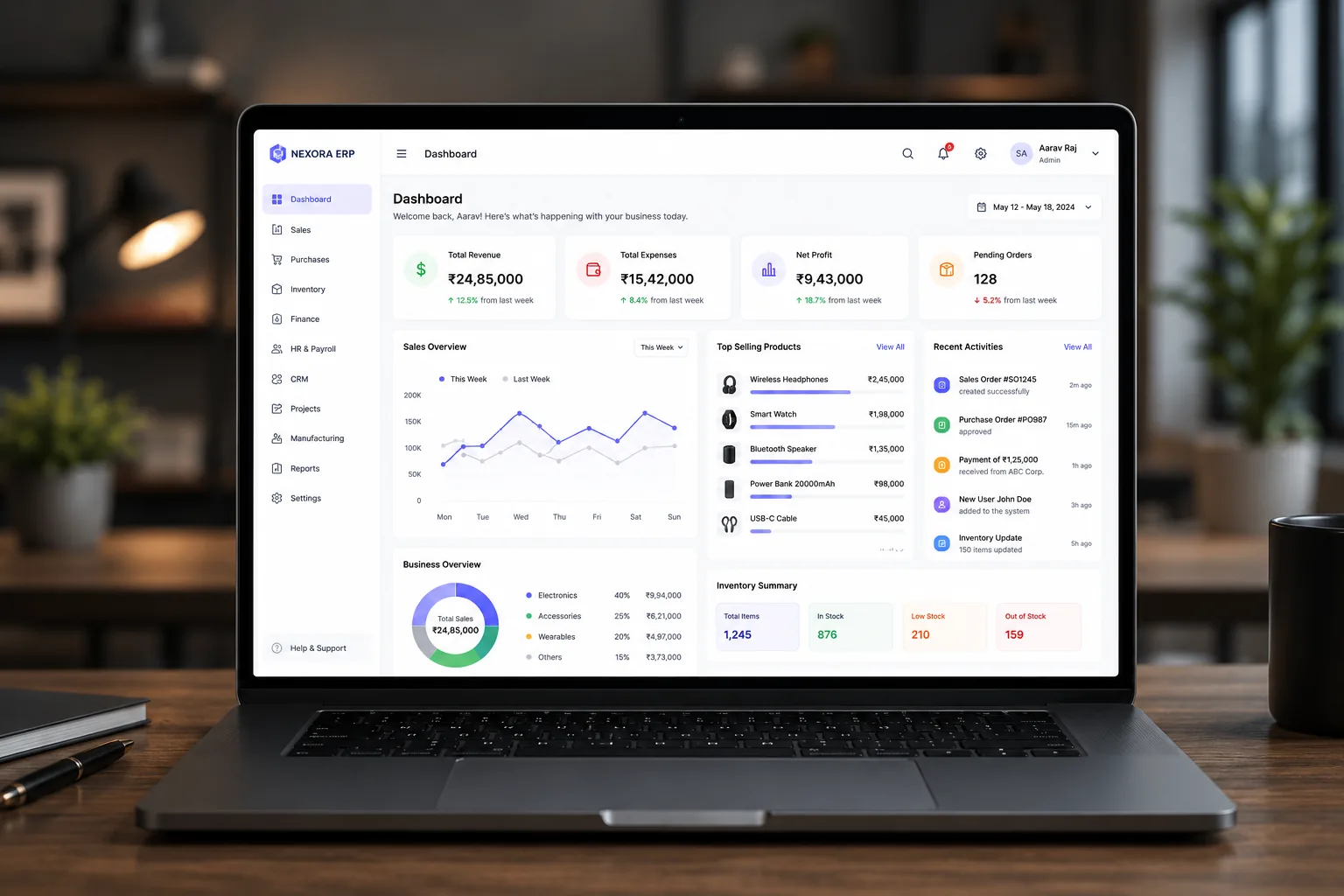
Emarath ERP
Inventory, procurement, finance, HR and reporting folded into one system with role-based access.

Mood By Teal
A mobile-first commerce experience for a design studio whose catalogue is the sales pitch.
Questions
How much does custom software development cost?
Most business systems land between a focused internal tool at the low end and a multi-module platform at the high end — in practice a range of roughly six to eighty lakh rupees, or about eight thousand to a hundred thousand US dollars. The spread is wide because the number is driven by the count of distinct user roles, integrations and workflow rules, not by the size of the company buying it.
Why do quotes for the same project differ so much?
Usually because the quotes are not for the same project. One may include discovery, design, testing, deployment and three months of support; another may cover only the code. Compare the deliverable list and the assumptions section before comparing the totals.
Is fixed-price or time-and-materials better?
Fixed price suits a well-defined scope that has already been through discovery — you trade flexibility for certainty. Time and materials suits work where the requirement is genuinely still forming. A fixed price quoted before anyone has documented the workflow is not certainty; it is a guess with a change-request process attached.
What are the ongoing costs after the software is built?
Hosting and infrastructure, third-party service fees such as payment gateways or SMS, and maintenance. A reasonable annual planning figure for maintenance is fifteen to twenty per cent of the original build cost, covering security updates, dependency upgrades, small changes and support.
Is custom software cheaper than a SaaS subscription?
Not at first, and often not for small teams. Custom software has a large upfront cost and a low marginal cost per user; SaaS is the reverse. The crossover depends on headcount and licence price — run it as a five-year comparison including your own maintenance, not as a first-year one.