

A working definition
Custom software development is the practice of building an application for one organisation, shaped around how that organisation already works — rather than buying a general-purpose product and reshaping the organisation to fit it.
That is the whole definition. The words bespoke, tailor-made and custom are used interchangeably for it, and none of them implies anything about the technology involved. A custom system might be a web application, a mobile app, an internal dashboard, an API that nobody outside the company ever sees, or all four connected together.
What the definition does imply is a relationship. A software product has thousands of customers and a roadmap that averages their needs. Custom software has one customer, and the roadmap is that customer’s operations. Everything that follows — the higher cost, the longer timeline, the better fit, the ownership — comes out of that single difference.
What is not custom software
The term gets stretched, usually at the proposal stage, so it is worth being precise about what falls outside it.
- A theme on a platform.A Shopify store with a custom theme, or a WordPress site with a page builder, is a configured product. Valuable, often the correct choice, but the logic is the platform’s and so are the limits.
- A brochure website. Content in a template is content in a template, however carefully designed. It becomes custom software when it starts carrying business logic — pricing a made-to-order product, showing a client their own data, holding inventory against a booking.
- A rebranded SaaS product. White-labelling changes the logo, not the behaviour. If the vendor can ship an update that changes how your process works, the process is not yours.
- Automations between existing tools. Wiring two SaaS products together is genuinely useful and often the right first step, but it is configuration until someone writes code that encodes a rule specific to your business.
None of these are lesser choices. The distinction matters for one practical reason: it determines what you can change later, and who you have to ask.
The build spectrum
In practice the choice is not binary. There are four positions, and most companies move rightward along them over time rather than jumping.
Off-the-shelf means using a product as sold. Configured means using its settings, fields and templates to get closer to your process. Extendedmeans writing code against its API or plugin system — you now own a piece of software, but it lives inside somebody else’s product and dies with it. Custom-built means the application is yours end to end.
When building pays off
Custom software is expensive and slow relative to buying, so it needs a reason. In our experience there are three, and a project wants at least two of them.
1. The process is a competitive advantage
If how you do the work is part of why customers choose you, software that encodes it is worth owning. If the process is standard — payroll, accounting, email — then a product already does it better than a custom build would, with regulatory upkeep included.
2. The workaround has a measurable cost
Two people spending three hours a day reconciling systems is roughly a full salary a year. That number is the honest baseline for a build. If nobody can name the cost of the current way of working, the case is not ready yet — not because the pain is imaginary, but because without the number you cannot tell whether you are solving it or gilding it.
3. Growth makes the current approach worse, not just annoying
Some problems stay the same size as a business grows. Others compound: per-seat licences, manual reconciliation, spreadsheet coordination. Those are the ones worth engineering out, because the case for it strengthens every year rather than weakening.
The question is never “is our process unique?” — every business believes that. It is “what does the current workaround cost us, and does that number grow?”
For a fuller comparison of the two paths, including the cases where buying clearly wins, see custom software vs off-the-shelf.
What you actually own
“Ownership” is the word most often used and least often specified. Before an engagement starts, four things should be named in writing:
- The source code, in a repository you control, from the first commit rather than at handover.
- The data, in a database you can back up, export and move without asking.
- The infrastructure accounts — hosting, domain, storage, third-party services — registered to your company, with your developer added as a user rather than as the owner.
- The documentation needed for a different team to take over: how it is deployed, what the environment variables are, where the secrets live.
A development partner who is comfortable with all four is telling you they expect to be kept for the work rather than by the lock-in. It is a reasonable thing to ask about at the proposal stage, and an unreasonable thing to discover two years in.
Once you know a build is the right shape, the next questions are practical: what these systems look like in practice, how one gets built, and what it costs.
Built this way
Two systems we designed around an existing operation rather than the reverse.
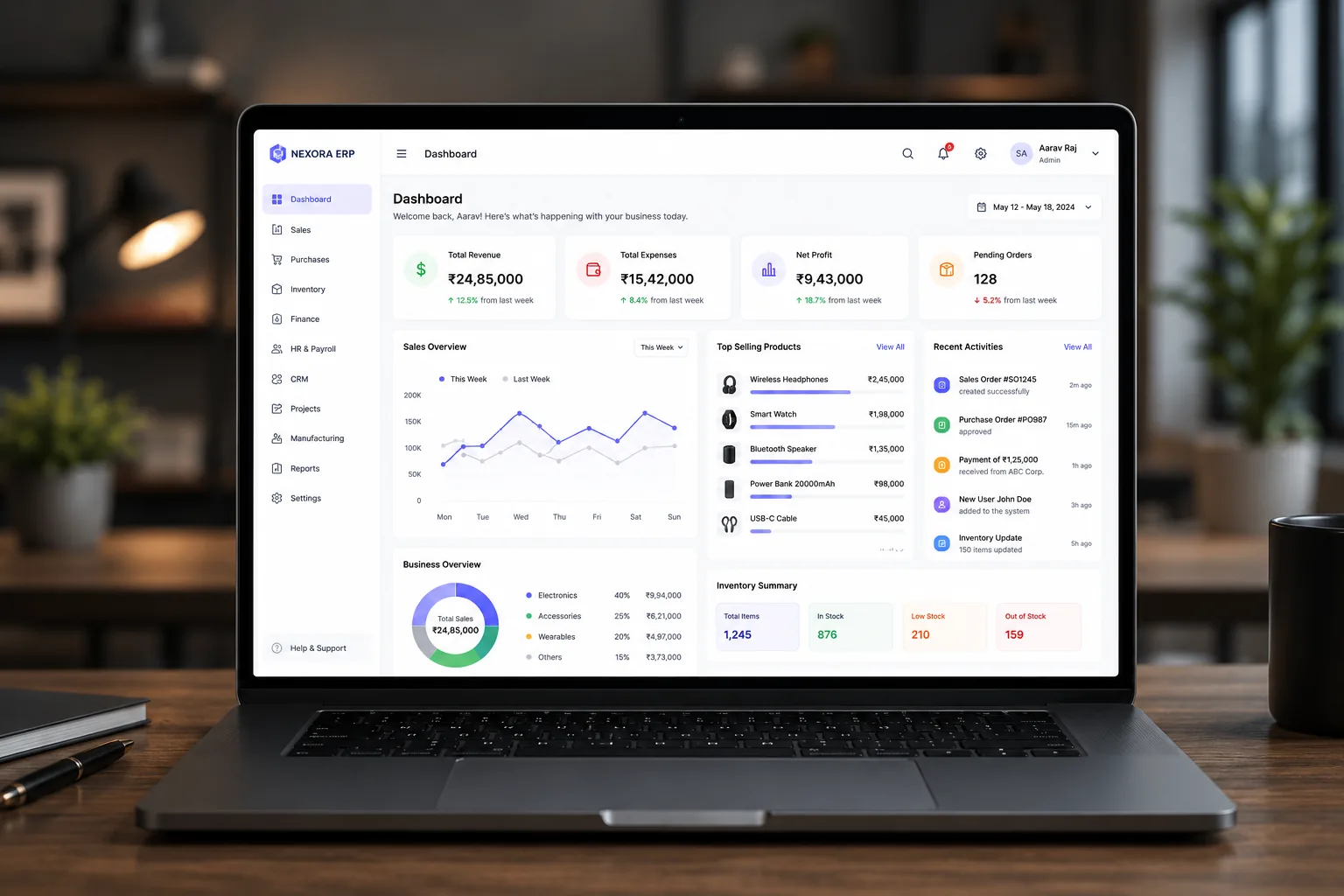
Emarath ERP
Inventory, procurement, finance, HR and reporting folded into one system with role-based access.
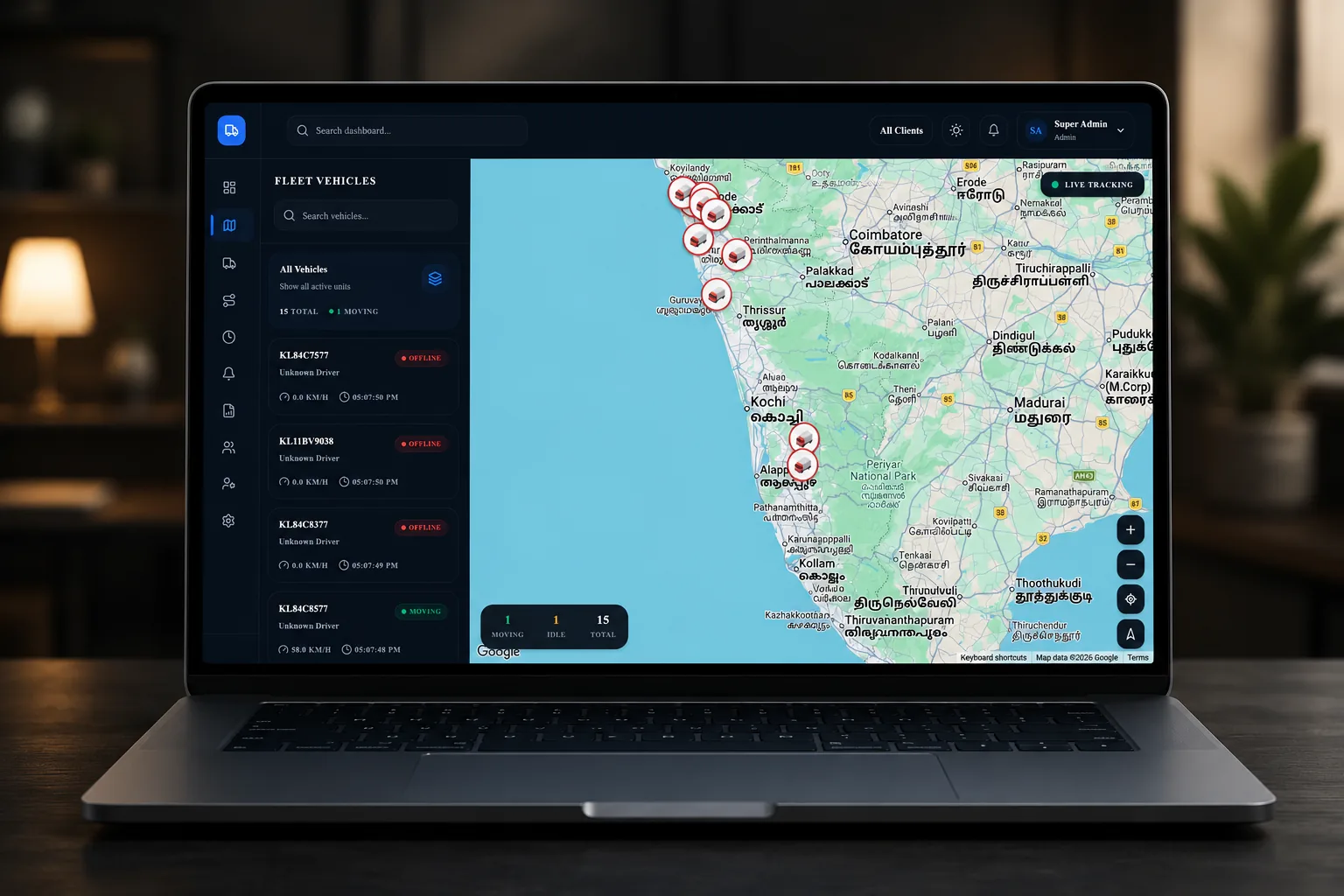
Fleet Management
Live GPS, fuel and expense tracking, and automated maintenance alerts across an entire vehicle fleet.
Questions
What is custom software development in simple terms?
It is building an application specifically for one organisation, shaped around how that organisation already works, rather than buying a general-purpose product and adapting your process to fit it. The result is owned by the business that commissioned it.
Is custom software the same as bespoke or tailor-made software?
Yes. Bespoke software, tailor-made software and custom software all describe the same thing: an application built for a named client rather than sold to a general market. The terms are used interchangeably across the industry.
How long does custom software take to build?
A focused internal tool that replaces a handful of spreadsheets typically takes six to ten weeks. A department-level system such as an ERP module or a fleet tracking platform runs three to six months. Anything quoted at two weeks is either very narrow in scope or is a configured off-the-shelf product being described as custom.
Do we own the source code of custom software?
You should. Ownership of the source code, the database and the deployment accounts belongs in the contract before work starts. If a development partner is unwilling to hand over the repository at the end of an engagement, that is a commercial decision worth discovering at the proposal stage rather than two years in.